Ðakovo, Croatia
by Valeria Teo
Ðakovo’s biggest traditional festival in the summertime is the Ðakovacki Vezovi which literally means “Ðakovo Embroidery” because Slavonian embroidery is a well-known Croatian craft.
The 43-year old festival lasts for two weeks. Starting from mid June, people come to Ðakovo to enjoy the best of the Slavonian traditions – delicacies, wines, arts, music and horse breeding. The last day of the celebration, always a Sunday, attracts the largest crowd. The grand day in 2009 falls on July 5.
The Ðakovo Tourist Office says that the number of people in the town doubles in the beginning of July every year. The additional bus service we found on July 5 might be the first evidence of its truth. The second evidence came when our bus was moving slowly into the town center at 8:30. We saw cars from all over Croatia and neighboring countries. All these visitors were going to the same place as we were – the St. Peter’s Cathedral.
 Pope John XXIII praised the Ðakovo’s landmark as “the most beautiful church between Venice and Istanbul.” We were impressed by the cathedral’s neo-Gothic-Romanesque style even without the Pope’s words. Before we had time to fully appreciate the magnificent cathedral, we had to join in the first program of the day.
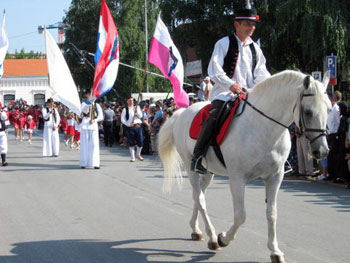
The streets outside the St. Peter’s Cathedral were already filled with festive crowd. Once the cathedral bell tolled at 9:00, everybody got their cameras ready for the most colorful parade in Croatia. More than 2,000 people in their folk costumes were singing and dancing in the procession. Participants came from every part of Croatia, Macedonia , Bosnia, Serbia etc. The wedding carriage and horsemen at the end of the procession revived memories of the Slavonian past. Summer was once the time for fun, feast and fete in the Croatian countryside.
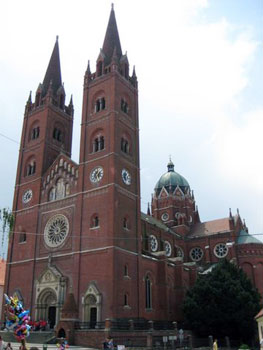 Religious practices have always been an integral part of all Croatian festivals. Ðakovacki Vezovi is no exception. Mass at the St. Peter’s Cathedral follows the parade.
We entered the church earlier to secure our seats. People were standing all around inside the colossal cathedral when the Mass started. Older people were in the majority. That did not come as a surprise as we had seldom met young people in most Sunday morning services.
I was likely to be the first Chinese receiving Holy Communion at the St. Peter’s Cathedral. Curious gaze followed me throughout the service. I could even tell from the children’s stare that they had never met any Chinese in their lives.
No Croatian festival is complete without an open-air market. We went slowly for our treasure hunt in the Ðakovo bazaar after the Mass.. Embroidery and other traditional arts and crafts were attractive to most visitors. We bought a bag with Slavonian embroidery at a bargain price. However, stall men were less willing to cut price later when more guests were arriving. The basic principle of supply and demand held true even in this rustic town.
The bazaar often smelt of savory local food. The aroma of roast lamb was the most inviting. It came from an old-fashioned rotating spit outside a restaurant. A man was roasting three full-sized lambs when we joined the queue to get a bite of the tender meat. It turned out to be a real treat!
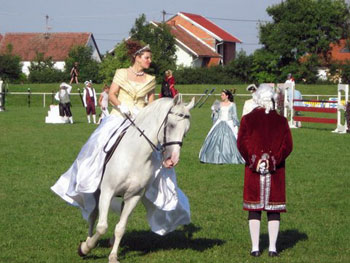 The highlight in the afternoon was equestrian competition and performance held in the hippodrome, showcasing the Lipizzaner breed. Ðakovo’s first official stud farm was founded more than 500 years ago, long before the Lipizzaner horses came to Ðakovo in 1806. But Ðakovo soon shifted exclusively to the breeding of these noble horses. The Lipizzaner breed has made Ðakovo famous beyond the Croatian borders for more than 200 years.
The Lipizzaner breed is interesting because they were not born white. Most Lipizzans were born dark—usually bay or black—and become lighter each year. The graying process is complete at between six and ten years of age. Adult Lipizzans are in fact gray horses with a coat of white hair.
 Visitors could go to the stable for a close contact with these beautiful creatures. To my surprise, the horses remained calm even though so many strangers were moving around them. In the meantime, the equestrians were busy preparing the horses for the performances at the hippodrome.
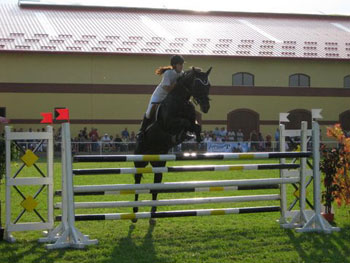
We knew nothing about dressage or show jumping. But for every walk, trot, canter and jump, we cheered and applauded together with the elated audience. The festive spirits diffused joy all around us.
The whole town was getting ready for the evening shows when dusk was slowly approaching. Staying a night in Ðakovo was necessary to fully experience the whole-day program. But we had to leave Ðakovo before night fell. Missing the best folk costume competition and the two concerts left us with some regrets in our otherwise memorable day in Ðakovo.
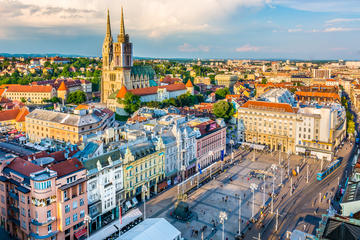
Private Full Day Trip to Croatia including Capital Zagreb
If You Go:
Ðakovo is well served by bus from Osijek, the third largest city in Croatia. The bus ride takes about an hour. It goes through the most beautiful farmland in Slavonia. In summer, passengers can see huge yellow sea of sunflowers. The Tourist Board of Ðakovo
About the author:
Valeria Teo and her husband divide their time between their home in Split, Croatia and Hong Kong. See their website at: www.freewebs.com/valeriaijosip
All photos are by Valeria Teo.



Leave a Reply
You must be logged in to post a comment.